Physics · InformaticsTheory

Charles Alexandre
Bédard

Researcher in physics & quantum information

I’m fascinated by the interplay between physics and computation. My research brings together quantum computation, fundamental physics, and algorithmic information.

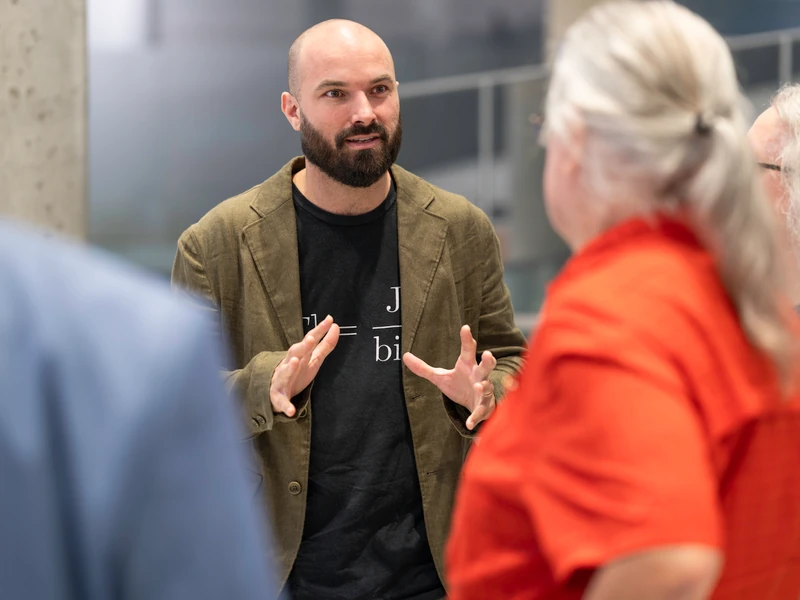
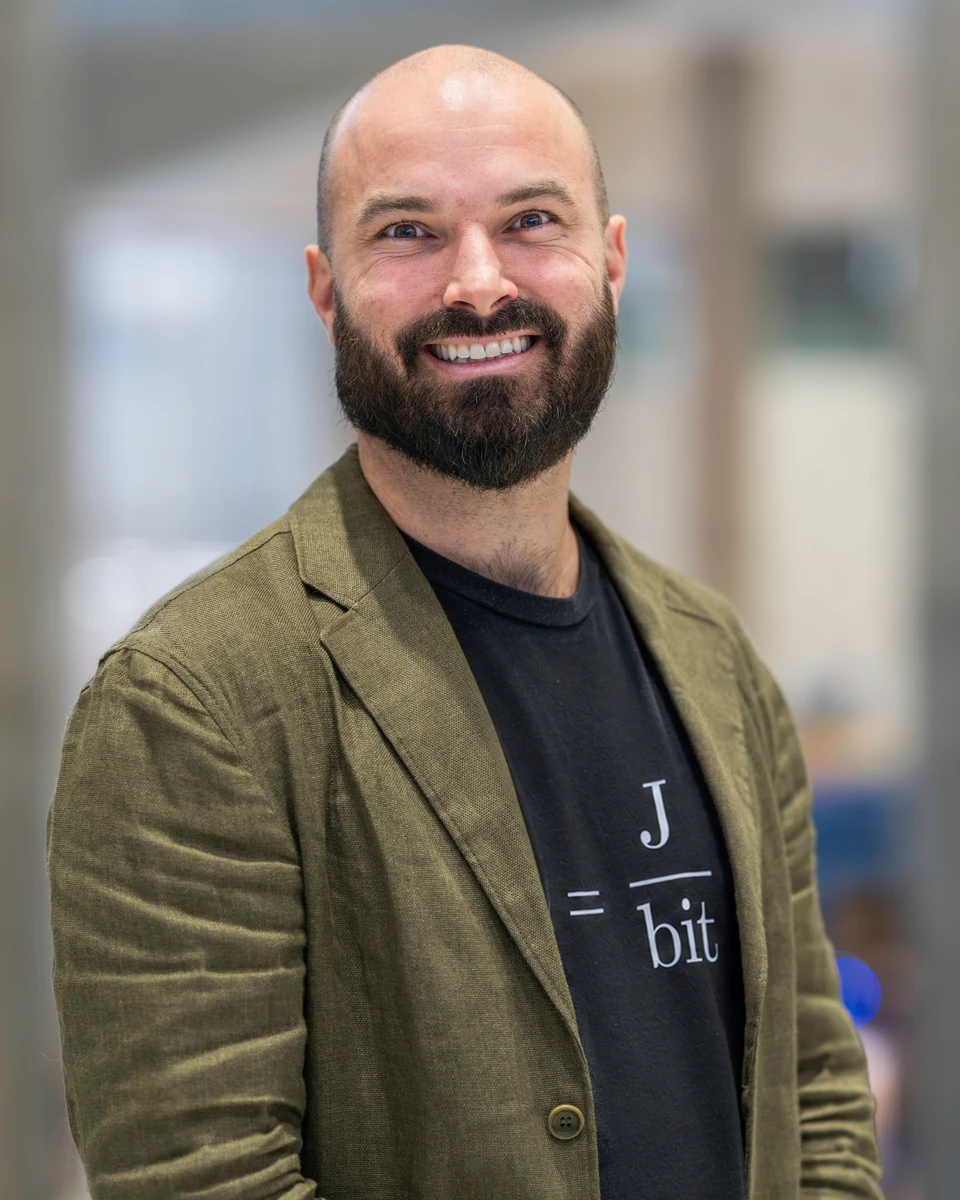
Charles Alexandre Bédard, wearing an olive jacket and a T-shirt with the J/bit motif.
Scientific coordinatorInstitut Gilles-Brassard pour l’informatique quantique fondamentale
Réseau québécois des chaires industrielles en communications quantiques

Research

Locality in Quantum Theory

I develop the explanatory power of Heisenberg-picture descriptors for quantum protocols, Bell correlations, and the emergence of classicality.

Article 2025

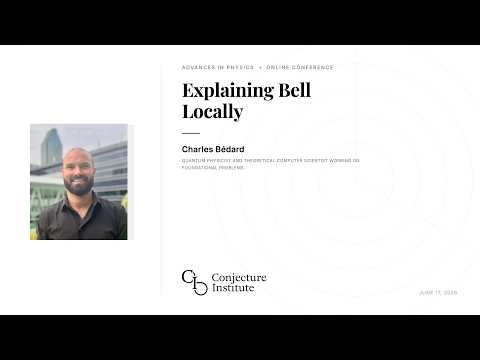
Explaining Bell Locally

In the Heisenberg picture of unitary quantum theory, Bell inequalities are violated with local elements of reality interacting locally. I analyze the comparison of measurement records as a quantum interaction, showing how the branching structure of the joint record produces Bell correlations.

Article 2021

The Cost of Quantum Locality

I unify three fully local formalisms of quantum theory and quantify their descriptive cost. The dimension of a single qubit’s space of local descriptions grows exponentially with the total number of qubits—a cost I show is expected for a local and complete account.

Article 2023

Teleportation Revealed

Using the Heisenberg picture, Deutsch and Hayden traced the flow of the apparently teleported state parameters through the two classical bits. I further develop this account, showing how the information survives decoherence and propagates through the local chain reactions of what we call classical communication.

Chapter 2026

Realism and the Inequivalence of the Two Quantum Pictures

The Schrödinger and Heisenberg pictures make identical predictions, but are not equivalent descriptions of reality: many distinct sets of Heisenberg descriptors correspond to the same wave function. Their additional structure enables fully local explanations of superdense coding, teleportation, branching, and Bell correlations.

Talk 2024

Causality in the Heisenberg Picture

When does one quantum system influence another? For unitary dynamics, I show how the simple requirement of functional independence between Heisenberg descriptors recovers the more intricate no-influence criterion used in quantum causal models.

Algorithmic Information in Physics

Rooted in computation rather than probability, algorithmic information theory quantifies the information intrinsic to an individual object. This objective approach to information offers a framework for studying thermodynamics and the nontrivial organization of complex physical systems.

Article 2025

Temperature as Joules per Bit

With Sophie Berthelette, Xavier Coiteux-Roy, and Stefan Wolf

Statistical mechanics treats entropy as fundamental, yet its unit, joules per kelvin, depends on that of temperature—even though temperature is itself defined from entropy. We resolve this circularity by giving entropy its own unit—the bit—and recover Gibbs's duality between free energy and available information capacity.

Article 2022

An Algorithmic Approach to Emergence

With Geoffroy Bergeron

We propose a quantitative definition of emergence based on multiple drops in the Kolmogorov structure function of observational data. These drops mark sharp gains in compression as models become more complex. We apply the framework to dynamical systems and thermodynamics.

02 / Teaching

Teaching

Teaching is sharing the beauty of ideas and an obsession with problems—then discovering, in their solutions, even better ones.

“Without exaggeration, the best course I've ever taken. […] The interest you sparked in me for quantum computing convinced me to pursue graduate studies and explore the field further. Thank you so much, Charles.”
Anonymous student evaluation · Quantum Computing, Université de Montréal (translated from French).

Algorithmic Information Theory

Doctoral course · Università della Svizzera italiana · 2023

Algorithmic information theory measures the information in an individual object by the length of the shortest program that produces it. This self-contained graduate course begins with codes and Shannon information, then reviews computability theory: universal Turing machines, the halting problem, and Rice’s theorem.

From these foundations, we develop plain and prefix complexity, connect randomness with incompressibility, and explore Solomonoff’s induction. Chaitin’s halting probability Ω and incompleteness theorem reveal quantitative limits on what formal axiomatic systems can prove. We then study the coding theorem, which links complexity to universal probability, and use lower semicomputable semimeasures to establish the chain rule.

My exposition moves freely between computer science, mathematics, physics, and philosophy. Originally taught at Università della Svizzera italiana in spring 2023, the course is freely available as a lecture series accompanied by notes and problem sheets.
Conversation · 2023

Bennett and Deutsch: The Nature of Computation, Incompleteness, and Mathematics

I moderated this conversation between David Deutsch and Charles H. Bennett for my course on algorithmic information theory.

Watch the conversation

03 / Service

Academic service

04 / How I approach science

Bold conjectures.
Open criticism.
Fun.

Science is too important not to have fun doing it.

The meeting of ideas and the search for better explanations are what bring me back to work each day—if we can call this work.

Charles Alexandre Bédard in conversation, gesturing with both hands, wearing his green jacket and J/bit T-shirt.

Contact

For research conversations, collaborations and invitations.